

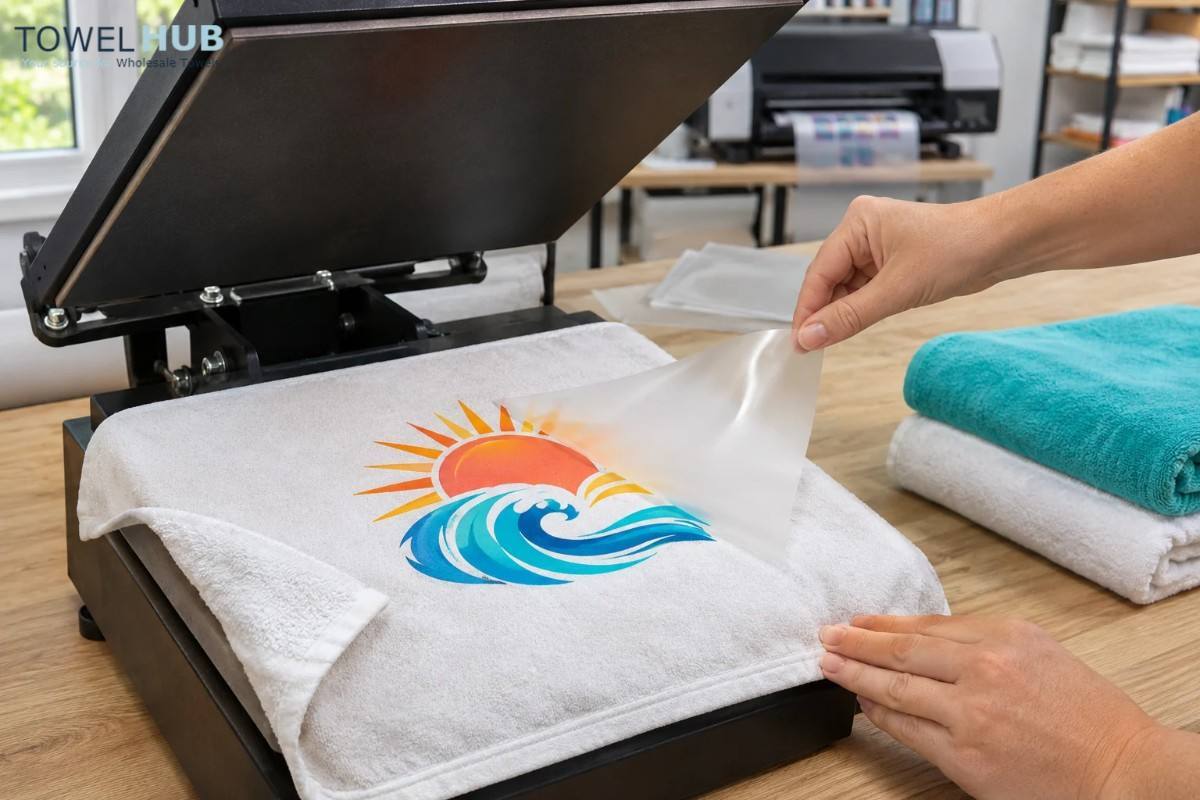
When using the DTF process to print onto these 2 materials (loop terry and sheared velour), you get less of a gap in the print than when printing onto plain loop terry. Fine text will break up on loop terry, giving a dotted pattern. On sheared velour, print is very crisp and seamless.
Despite it being down to the material rather than the printer, of all the terry towels available to decorators, 100% cotton terry velour towels give the best results for DTF printing. They give a flat surface, a high amount of heat transfer, and still dry quickly like a towel. There are some limitations, but they can be easily accounted for.
Cotton Terry Velour Towels Explained
Terry velour towels are made by cutting back the pile of one side of cotton terry towels with a shearing blade in the manufacturing process. The other side remains untouched.
The Sheared Front
This has a short, tight pile. It is very dull and gives the tactile feel of velvet, hence the name. This is the side used for printing.
The Looped Back
The other side of the towel contains loops in the pile, meaning it has very absorbent properties. Most wholesale terry velour towels you can get in bulk will have 2 sides like this. From finger sized to beach size towels. If a towel is fully terry, then both sides will contain loops. Microfibre is different. It is a synthetic knit and has different heat limitations.
How Velour Improves DTF Print Quality?
How The Bond Forms
DTF transfers are created by printing CMYK inks on a PET film substrate. After printing, hot-melt powders (usually a TPU mix) are applied to the wet print. Once cured, the powders are melted down inside the heat press and penetrate the fabric. Once cooled, the design is fixed in place. The strength of this adhesion is highly dependent on good contact between the powder and fabric.
Where Loop Terry Struggles
The looped texture does not allow for good contact. The film sits on top of the tips in each loop, leaving empty gaps. The hot-melt powder therefore does not bond with the cotton, but instead with air. Thin lines break up; small text appears soft and vulnerable points often begin to crack in washing.
Cleaner Edges On Velour
As the pile is sheared, most of the hollow areas have been removed. Even pressure is applied to the design, meaning the hot-melt powder is in contact with the material almost perfectly. Thin fonts, intricate lines, and gradient images all perform much better. To compare how these 2 materials perform on actual prints, take a look at this terry velour print comparison.
Why Cotton Fiber Suits DTF Heat?
Full Press Temperature
DTF printing is undertaken at a temperature between 300-325ºF (149-163ºC). The cotton terry velour does perfectly well within this range. However, printing polyester towels may need to be at a lower temperature to avoid the glossy platen marks, meaning the adhesive may not fully melt.
No Dye Migration
Polyester fabric can cause dye bleeding. When printed on a coloured polyester, the heat in the printer can cause the dye to form gases and rise into the white ink. This causes a colour change.
For example, a white logo printed onto a red polyester towel may look clean when printed, but after a matter of days may turn pink. However, most cotton towels are dyed using reactive dyes. This means the dye bonds with the fibre and the colours will not bleed.
Longer Wash Life
Gym and salon towels may be washed in hot water daily. As the adhesives have melted well, the design can move and flex during folding, twisting, and tumble drying. The print moves with the fabric.
Everyday Advantages Of Velour Blanks
Prints On Any Color
Unlike sublimation transfers, which require light or white polyester, DTF transfers include a white base layer. This means designs can be vibrant on dark colours such as navy, black, maroon, and Kelly green. Team and club colours are no longer an issue!
Absorbency That Still Works
As microfibre or double-sided velour can sacrifice print quality for absorbency, terry velour towels do not suffer from this problem. The back side is still looped. Therefore, as a towel that is drying hands is in use, the logo is always visible.
A Retail Look
Velour gives a soft, glossy finish, whereas terry would not. After printing, velour blanks appear like shop products and allow you to charge more than you could with a basic promotional towel.
Best Uses For DTF Printed Velour Towels
Golf Courses And Pro Shops
Golf towels need to be attached to bags, wipe muddy clubs and remain legible with club logos even after 18 holes. This 15x18 folded towel with cotton terry velour will give clear logos on the front and functional loops on the reverse.
Gyms, Spas And Salons
Gyms, spas and salons often order multiple hand towels in their brand colours. They need to allow space for a logo on the front, and plenty of loops on the back to endure frequent use on busy reception desks or styling stations.
Teams, Rentals And Events
Rally towels for school team building nights, branded towels for holiday lets and free towels at company events can all be achieved using terry velour towels. These towels have a crisp print on a soft cotton substrate.
Pressing Tips For Velour Blanks
Prep The Surface
Before printing, we recommend running a lint roller over the surface. This will reduce any loose fibres in the fabric, which could cause tiny dots to appear in the print. Drying the towel for 5-10 seconds will also help make the surface flat. Full timing, pressure, and peeling recommendations can be found in detailing DTF pressing temperatures for cotton velour towels.
Keep Hems Off The Platen
As hems & dobby edges will be thicker than the main part of the towel, printing over them will reduce pressure applied to the rest of your design. Move the design so that it is not printing over the hem, or add a pressing cushion to even out the pressure.
Size Art To The Towel
Areas that have been printed on are less absorbent and slightly stiffer than unprinted cotton. By keeping the logo away from the hem or centring the design, most of the towel will remain soft. If the entire towel has been printed, the towel will no longer be functional and can act as a display board.
Choosing The Right Velour Blank
"The beginning is half of the whole." This is very relevant when printing towels.
Check The Fiber Content
Although the term ‘velour’ is used, many sublimation velour blanks will have a polyurethane surface. As discussed previously, this can cause issues with heat and dye. For DTF, we would expect to see ‘100% Cotton’ in the specification sheet.
Compare Size And Weight
Generally, heavier terry velour towels (per dozen) mean a denser pile. Dense piles mean a smooth surface to print on. The size depends on the application. Rally and fingertip towels will be 11 x 18 cm. Beach towels should be larger, at 30x60cm or 35x70cm. Gym or spa towels would be best suited to 16x26 hand towels. This size is a good medium-size option and available in over a dozen different colours.
Test Before Buying In Bulk
Print a few samples with the final design. Wash 5/6 times and check the edge, colour and texture. Although a small sample run costs very little, it can prevent issues in large orders of 500 items.
Frequently Asked Questions
Can I print DTF on Terry Towels?
Yes. As loops are present, it is best to design for bolder images and avoid intricate design details.
How long will DTF last on Towels?
If pressed correctly, printed terry towels can be washed many times. Allowing 24hours before washing, avoiding chlorinated bleach and tumble drying on medium heat will help increase the lifespan of the design. It might be helpful to share these care instructions with customers.
What temperature should I print DTF On Cotton Towels?
Printing temperatures will typically be between 300-325ºF (149-163ºC). We recommend beginning at the temperatures recommended by your film manufacturer.
Is DTF a better printing method for coloured towels?
Yes. If printing on cottons and dark colours, sublimation requires light colours or white polyester. DTF can be printed with its own white base.
Which side of Velour Towels should I print on?
Sheared side. The smooth surface ensures even application of the design. The looped backing allows for airflow and drying.
Final Thoughts
Choosing the correct blank for DTF printing, along with high-quality films and correct heat settings, will ensure perfect results. 100% cotton terry velour towels can provide the best results for sharp DTF prints straight from the press, and retain sharpness after many washes. They have a smooth surface, can handle high heat, and have functional terry backs.
We supply wholesale 100% cotton velour blanks. Orders can be dispatched same/next working day from Atlanta, GA. Get samples, test print with your own design, and get printing with confidence.