
Start a Towel Printing Business With Low Startup Costs
Nov 18th 2026

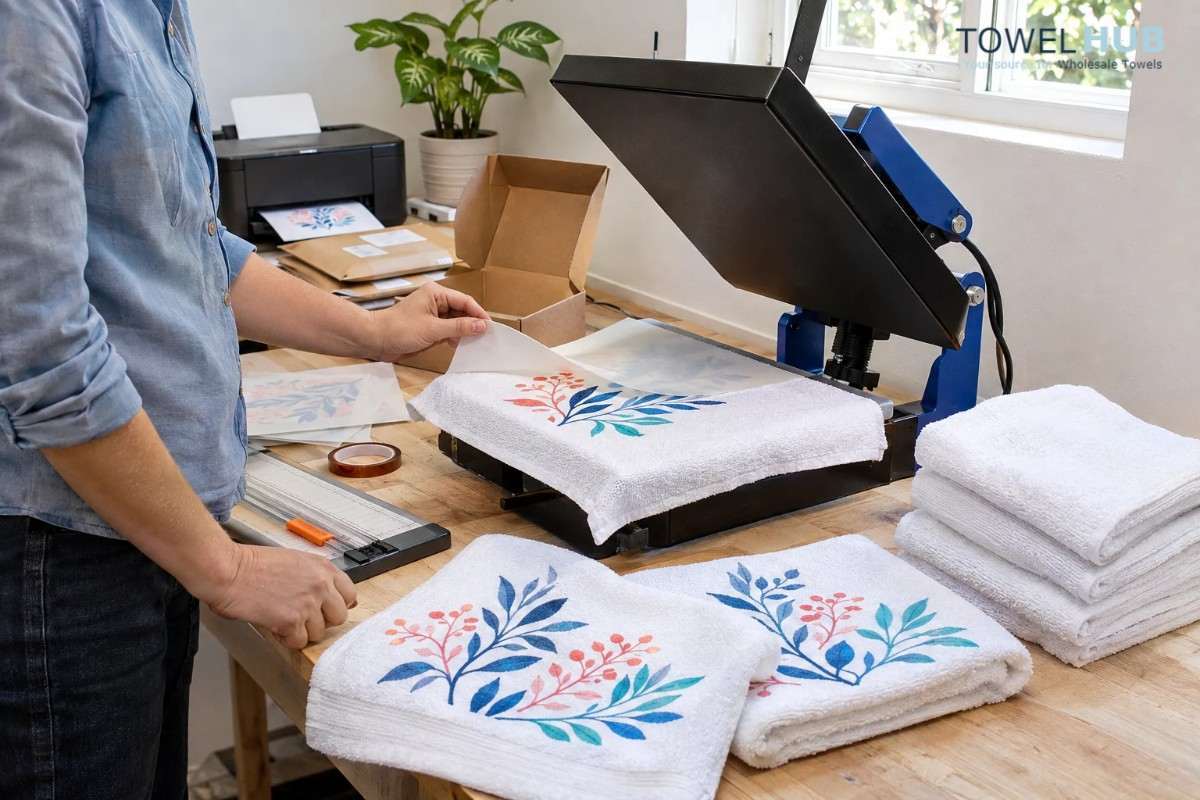
There are several high costs in screen printing. Screens, plastisol inks, flash units and high volumes to allow set-up costs to be covered across multiple colours are required.
There are no screen disposal costs, additional colours do not incur set-up costs, and 1 or 500 towels use the same process. This will have a large impact on planning a new towel printing business with a limited budget.
The Basics Of A DTF Towel Printing Business
DTF (direct to film) printing uses CMYK and white inks to print to a sheet of PET film. After the film has been printed, an adhesive powder is shaken over it. It is cured in an oven to leave a thin adhesive. Lastly, the transfer design is heat-pressed onto fabric.
Only 3 components are required to print a towel: blank towels, a transfer design and a heat press. As components are added one at a time, the business is not put at risk by one spend.
Why Towels Beat T-Shirts As A Starter Product?
Repeat Buyers In Every Town
Towels see heavy usage and are easily lost in changing rooms or given away at events. This means regular re-orders from golf clubs, gyms, salons and sports teams. For example, many booster clubs regularly re-order rally towels in readiness for playoffs. If a printing design is popular with a team in one season, it is very likely they will go back to the same printer in future seasons.
Better Margins Per Piece
Cotton velour towels with printed designs appear more like gifts, meaning businesses will pay more for them than they would a printed T-shirt. Despite similar decoration costs, corporate customers pay more.
Fewer Sizes To Stock
T-shirts must be stocked in a wide range of sizes, from S to 3XL. However, towel sizes are limited (for example: Golf towels, Hand towels & Beach towels). Therefore, much less stock money is tied up in inventory.
Stage One Begins With A Quality Heat Press
Transfers and blank towels can be purchased when orders come in.
Spend Most On The Press
Many mistakes are made with cheap presses. Due to thin platens in cheap presses, thick towels can cause bubbles in the corners and inconsistent adhesive lines. This was a problem highlighted by Terry Combs (a decorator with over 45 years of experience) in Impressions in June 2026.
Buy Transfers After The Sale
As transfers are purchased once customers have paid, risk is minimised. In addition, you will be able to gain plenty of experience in printing, pricing and delivery without having invested any money in printers. Initially, send the same design to 2 or 3 transfer providers. Compare the quality of colour, fine details around edges and durability of prints after 5 washes.
Pick A Velour Face Blank
Terry towelling has a looped surface. However, this can create an inconsistent surface for the film to adhere to. Velour is terry towelling with one side sliced flat, meaning a smooth surface for transfers. Comparing terry and velour towels, we can see how much the surface affects the print.
Stage Two Moves Printing In-House
The Cost Per Square Foot Test
Once transfer designs are regularly included in weekly invoices, it may be worth investing in in-house printing. Purchased transfers average $4.50 per square foot. Printing in-house costs between 0.50-0.80 (film, ink, powder). Therefore, consider investing in a printer if these savings add up. Base this decision on actual sales volumes from the past 2-3 months.
Entry Printer Setup Costs
To start a small printing business, you will require an A3/13inch DTF printer, powder shaker/tray and a curing oven. According to cost guides from 2026, initial costs for a small printing business will be around 2500-5000. Software (RIP) and initial inks/films/powders will add to this cost.
Space, Humidity And Upkeep
If printing in a garage or spare room, ensure there is good airflow. If humidity drops too low, ink can begin to dry out in the print heads. Try to keep humidity at 40% or above. Replacing just one head can cost from $ 1,500 to $ 2,000. Spending just 10 minutes each morning cleaning will save you much more money.
Stage Three Turns The Shop Into Production
Faster Printing And Pressing
Weekly team and corporate orders push the shop toward speed. The usual upgrade is a 24 inch roll-to-roll printer with an inline shaker and dryer. On the pressing side, a pneumatic press or a second clamshell press lets two people work at once. Small business production setups usually land between $5,000 and $10,000. Full commercial lines start near $10,000 and climb past $25,000.
Gang Sheets As Extra Revenue
A roll printer will have quiet hours. Printing gang sheets for crafters, small shops and local teams fills that time and smooths out slow towel months.
Local Buyers Who Order Towels Most
Golf Courses And Country Clubs
Printed towels will be required for players in tournaments, and logo printed towels will be stocked in pro shops throughout the year. If possible, bring in fully printed samples. Including your club logo on white towels (from a bulk wholesale range) demonstrates the kind of product members will receive.
Gyms, Salons And Spas
Towels are given to new clients in gyms. In salons, printed towels can be sold at reception. Towels will be reordered when stocks are running low.
Businesses Buying Client Gifts
Real Estate agents, Banks and Insurance Offices all give gifts to clients to leave at their homes. Hosting vacation rentals and boutique hotels will include printed towels in welcome packs.
Pricing Printed Towels For Profit
Labour. Approx 1 minute per towel (excluding loading, pre-press, pressing and peeling).
The Four Real Costs
- Printing/Transfer costs
- Labour. Approx. 1 minute per Towel (excluding loading, pre-press, pressing and peeling).
- Packaging & Delivery.
- Blank Towel + Delivery costs
Blanks are the most controllable cost. However, buying cotton terry velour towels in bulk (12 per dozen), and only buying when orders have been confirmed, will help keep this cost low and free up space in your garage.
A Worked Transfer Example
If your logo takes up an area of 10 in x 10 in (approx 0.7ft 2), it will cost approximately $3.10 if transfers are purchased at an average cost of $4.50. If transferred in-house, this reduces to approx. $ 0.35—$ 0.56. Multiple logos can be nested in a gang sheet, reducing this cost further.
Setup Fees And Volume Breaks
An artwork set-up charge will be required for every new design. After this, quantity discounts for 24, 48 and 144 units will encourage people to order a larger quantity.
Press Settings That Prevent Waste
It is very wasteful to ruin a towel. This is usually due to excess moisture. To prevent this issue, pre-press the towels until there is no steam coming from them. Press at 300-325F for 12-20 seconds with a medium-firm to firm pressure.
To seal the edges, perform a brief second press using parchment paper. If the thick hem of the Towel means the platen is not sitting flush with the printed part, place a pressing cushion under the design area. A detailed breakdown of how to perform DTF printing on cotton velour towels can be found here. If your transfer supplier recommends different temperatures, follow these.
Frequently Asked Questions
How Much Does It Cost To Start A Towel Printing Business?
Starting with bought transfers mainly requires a heat press, and a good one costs about $1,200. You buy blanks and transfers per order. An entry DTF printer setup adds roughly $2,500 to $5,000 later.
Can DTF Transfers Be Pressed On Towels?
Yes. They bond best to a smooth face such as cotton velour. Pre-press out the moisture, use firm pressure, and test one towel before the full run.
Which Towel Works Best For DTF Printing?
Cotton terry velour suits most jobs. Its sheared front gives the film a flat surface, while the looped back keeps the towel absorbent.
Is A DTF Printer Needed To Start?
No. Many shops run on bought transfers and a heat press for months. A printer becomes worth the money once transfer spending stays steady every week.
Is DTF Cheaper Than Screen Printing For Towels?
On short runs and full-color logos, it usually is, since DTF needs no screens or per-color setup. Screen printing can still win on large one-color runs.
Bottom Lines
Profit margins are decided before printing even begins. This depends simply on the price of the blanks. We can supply 100% cotton terry velour towels wholesale, and we ship orders placed before 1 pm EST, meaning that you only have to buy what you need for each individual order. Get wholesale pricing from Towelhub and get accurate price points for your next order of towels.