

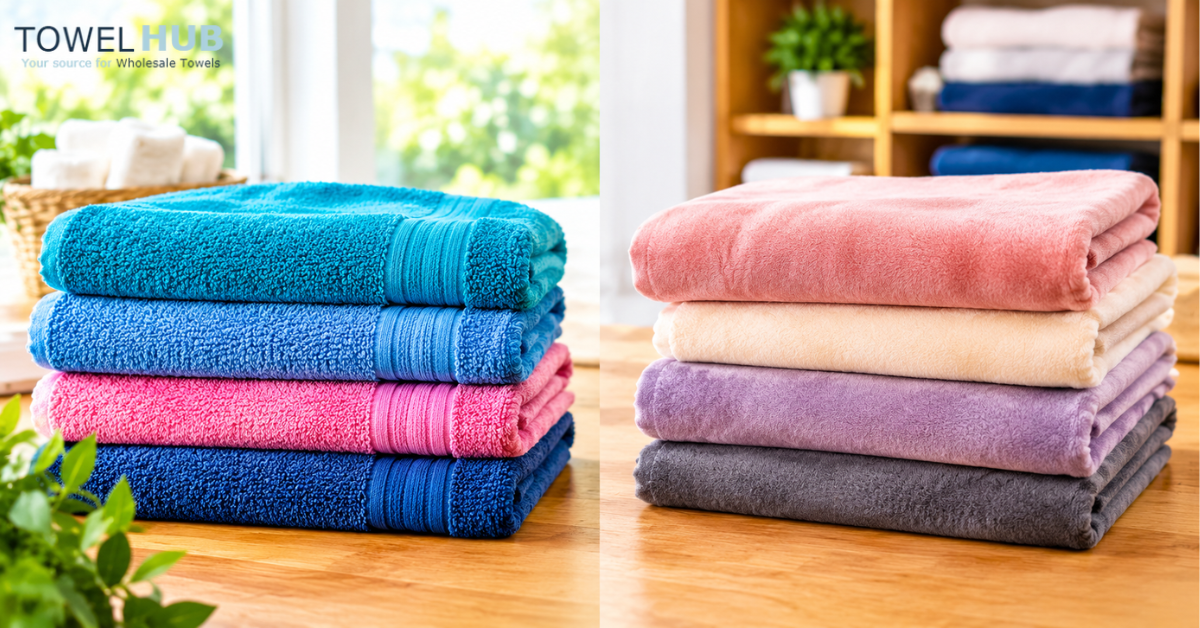
A logo that looks razor sharp on the proof can come back soft at the edges. The letters seem to have sunk into the cloth. More often than not, nobody made a mistake at the press. The blank was full Terry.
Terry and velour start as the same woven cotton, yet they print so differently that the choice between them shapes how most printed towels turn out.
Before you order custom printed towels, it helps to know what each fabric does to ink, thread, and film.
Terry And Velour Basics For Printed Towels
On the loom, the two are identical. The split happens later, at the finishing stage.
How Terry Cloth Is Made
Terry gets its texture from a second set of warp yarns (the pile warp) held at low tension during weaving. When the reed beats a group of weft picks home, that slack yarn buckles into loops on the front and the back.
Thousands of loops per square inch is great news for drying and bad news for decoration. Under a magnifier, a terry face looks like a lawn nobody has mowed in weeks.
How Velour Is Made
Velour is that same lawn after a haircut. A shearing machine runs across one face, opens the loop tops, and crops the pile to a short, even nap. The other face keeps its loops for soaking up water. Suppliers usually list the result as terry velour, and our wholesale terry velour towels follow that two-face build.
Touch the sheared side and it feels closer to suede than to a bath towel. For a printer, flat is good. Most printed towels made for golf and promo work carry their artwork on that face.
Print Results On Terry And Velour
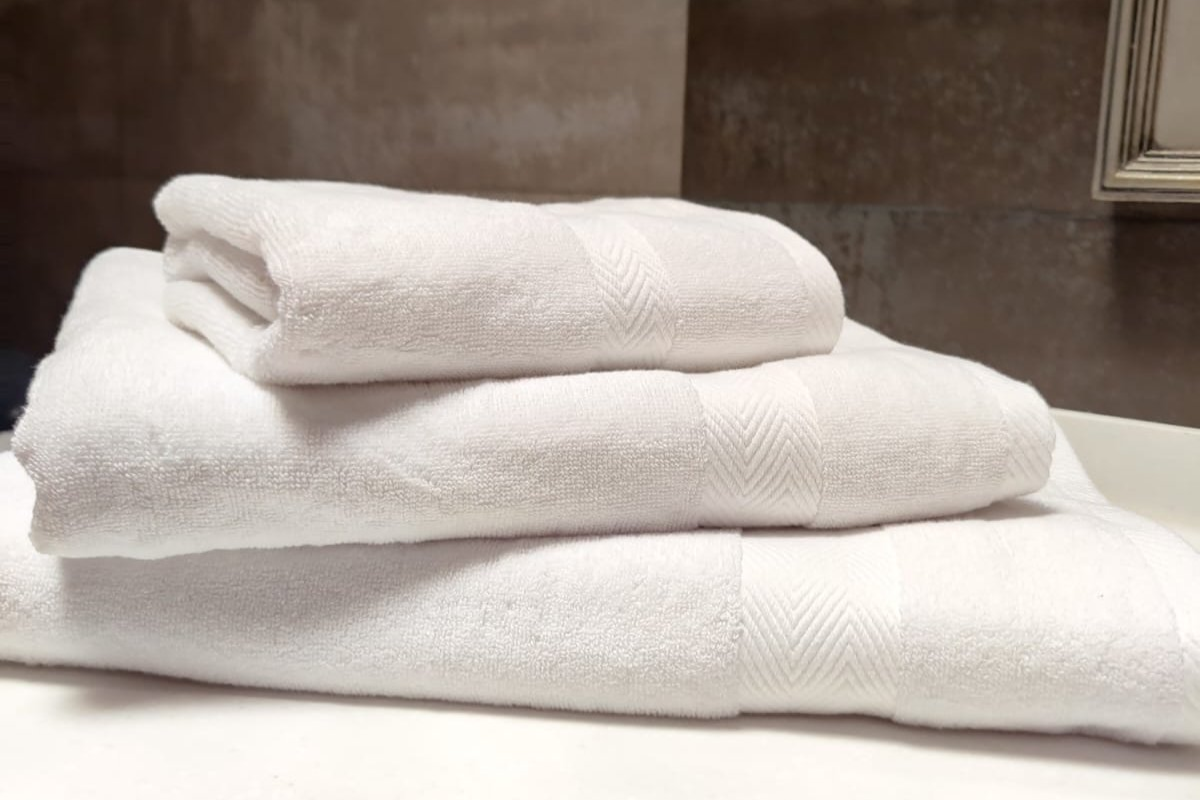
William Morris once advised, “Have nothing in your houses that you do not know to be useful, or believe to be beautiful.” A towel with a logo is supposed to be both. The method of towel printing you choose decides how much of the beautiful part the fabric lets through.
Screen Printing Results
Plastisol doesn’t soak in. It sits on the surface and cures at roughly 320°F, so on terry it lands on loop tips and skips the valleys between them. Hairlines vanish. Small text clogs. Printers can force coverage with a heavier deposit or a flashed underbase, but the towel then feels like it has a patch glued on.
Screen printing towels with a velour face avoids most of that, because the sheared nap gives the squeegee an even surface. Halftones hold and edges stay clean. Water-based or discharge inks sink into the cotton and leave printed towels with very little stiffness.
Sublimation Needs Polyester
Cotton and sublimation simply don’t mix. Sublimation dye turns into a gas at around 400°F and bonds only with polyester, which is why dye-sub blanks pair a polyester velour face with a terry back. Shopping for sublimation towel blanks? Read the fiber content of the print side before anything else. Press a transfer onto a cotton face and the image will look fine for about one wash.
Embroidery And DTF Transfers
Thread copes with terry better than ink does, although the loops still cause trouble. They push up between satin stitches, and lettering ends up looking fuzzy. The usual fix is a water-soluble topping, a clear film hooped over the towel that keeps loops flat while the machine runs and dissolves in the rinse.
Velour seldom needs one. Its short nap gives the needle a firm floor, though a dense fill can still pucker where the shearing runs thin. DTF is the least picky method of the lot, but the film copies whatever sits under it, so it turns out bumpy on terry and smooth on velour.
Absorbency And Weight Of Printed Towels
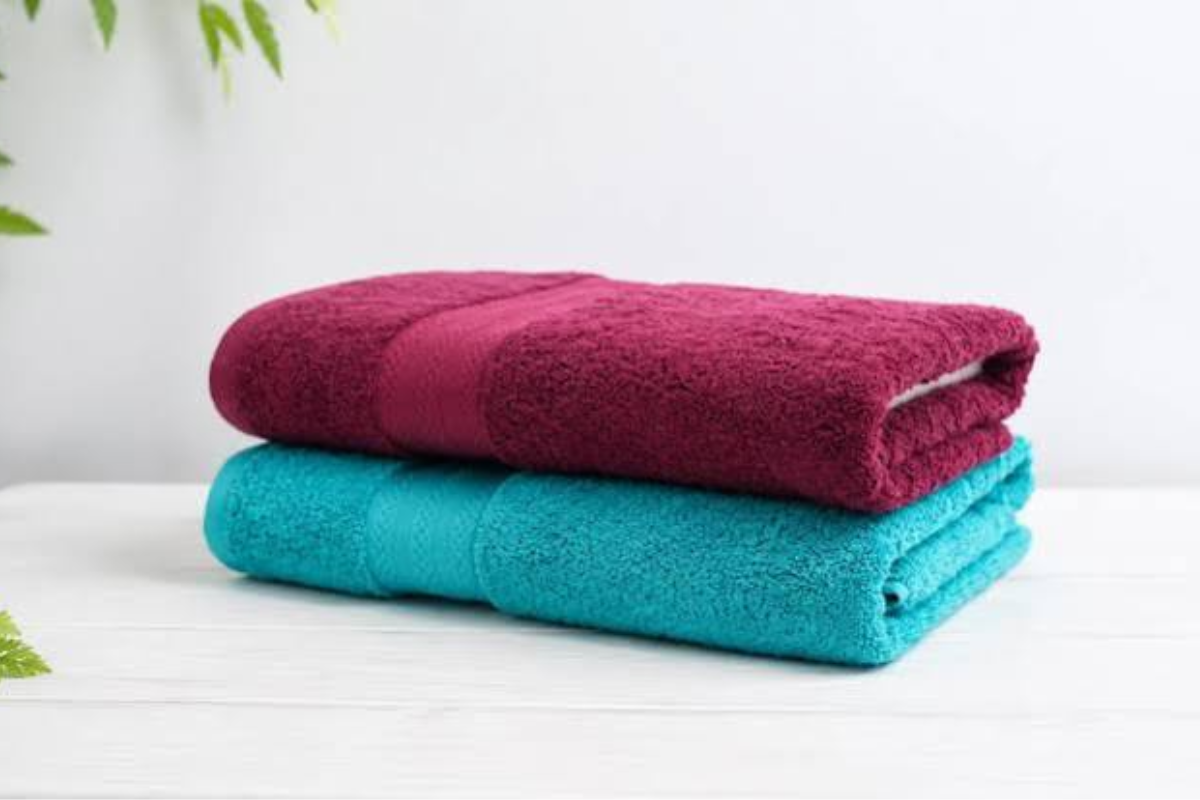
A gorgeous print on a towel that won’t dry anyone is still a bad towel, so performance deserves equal attention.
Absorbency On Each Fabric
Cropping the loops costs a little absorbency on the velour face. Not much, since the looped back still handles most of the water. A swimmer wrapped in a beach towel will still feel it. When drying is the whole point, full terry towels are the better buy.
Golf is another story. A golf towel spends most of its life clipped to a bag where people can see it, so for printed towels like these the logo matters more than a few grams of water.
Weight And GSM Ranges
Spec sheets list weight either as GSM (grams per square meter) or as pounds per dozen. Mixing the two up is an easy way to misread a quote. Promotional and rally towels usually run 300 to 400 GSM. Most gym and mid-range beach towels land between 400 and 500, and spa towels go heavier still.
A few quick conversions show how the numbers line up. A 16x26 cotton terry velour hand towel at 3.2 pounds per dozen works out near 450 GSM. A 30x60 beach towel at 11 pounds per dozen is about 360 GSM, while a 35x70 at 20 pounds per dozen reaches roughly 480. Ask for both figures on any quote for bulk towel blanks.
Choosing The Right Fabric For Printed Towels
Start with the side-by-side below, then match it to how the towel will be used.
|
Feature |
Full Terry |
Terry Velour |
|
Print Face |
Open loops |
Sheared, flat nap |
|
Fine Detail |
Softens |
Stays sharp |
|
Sublimation |
Not on cotton |
Yes, on a polyester face |
|
Embroidery |
Needs topping |
Rarely needs topping |
|
Absorbency |
Highest |
Slightly lower on the velour side |
|
Common Uses |
Rally, gym, pool |
Golf, beach, retail |
Beach And Pool Towels
Most large beach towels sold for printing are terry velour, with the design on the sheared face and plain loops behind it. Full-color art goes on easily. For a dye-sub design, stick with polyester-faced sublimation towel blanks, because cotton velour will not hold the dye.
Golf And Rally Towels
Golf clubs tend to pick velour towels. An embroidered crest stays crisp through dozens of washes and rides around the course on every member’s bag. Our post on how golf clubs turn towels into merchandise goes deeper on blank weights, grommets, and pro shop pricing. Rally towels sit at the other end of the budget.
Fans mostly wave them over their heads, so a light full terry blank with a one-color logo keeps the unit price down. Shops screen printing towels for stadium nights often run them by the thousand.
Spa And Hand Towels
Spas and hotels want function first. Embroidered towels with a small logo by the hem look tidy and leave the drying surface alone. Keep thick plastisol away from any part that touches skin, because it feels stiff when wet.
Washing Printed Towels Without Fading
Plenty of towel printing problems only show up after a month of laundry. Run new towels through the wash before first use, sort colors, and leave fabric softener out, since it coats the fibers and cuts absorbency. Chlorine bleach strips most dyes and many screen inks, so save it for towels built to take it.
Frequently Asked Questions
Which Side Of A Velour Towel Do You Print On?
The sheared side. Its flat nap holds ink and stitches evenly, so fine detail survives. Leave the looped side for drying.
Can You Sublimate On Terry Towels?
Not on cotton terry, since sublimation dye bonds only with polyester. Seeing doubled or shadowed images on a poly blank? Our guide to why sublimation towels ghost during heat pressing covers the common causes.
Are Velour Towels Less Absorbent Than Terry?
A little, on the sheared face. A two-sided terry velour towel still dries well because the looped back keeps its full surface.
What Fabric Works Best For Embroidered Towels?
Velour gives the cleaner stitch-out, as the short nap stops stitches from sinking. Terry works too if you hoop a water-soluble topping over it.
How Should You Test A New Towel Blank?
Print your real artwork on two or three blanks, wash each one five times, and compare edges, color, and feel side by side. Sampling costs far less than reprinting a whole run.
Bottom Lines
Full terry dries faster and handles bold, simple art. Velour gives printed towels sharper detail and a firmer base for thread, and its looped back still does the drying. Settle the decoration method first, then choose a weight that fits your price.
Compare wholesale terry velour towels, full terry, and sublimation-ready options side by side at TowelHub. Order samples of your top two or three, put your own artwork on them, and then buy bulk towel blanks for the whole job.