
What Care Homes Should Look for in Reusable Bibs?
Nov 26th 2026

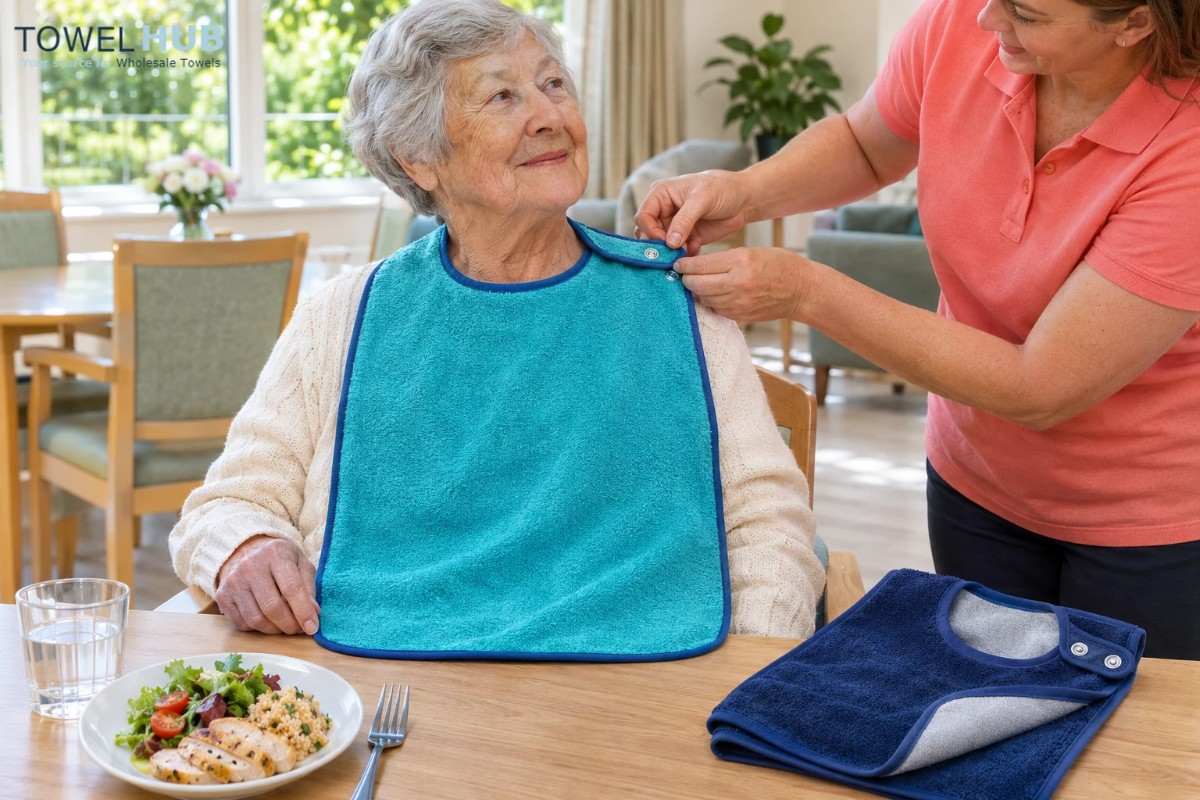
Reusable bibs are the most frequently used fabric item in care homes. Residents have meals, a mid–afternoon coffee and a snack, which can all involve drinking or consuming soup, and so there is potential for these to be splashed onto a person’s shirt.
Appropriate bibs can largely avoid this. However, inappropriate bibs are often stored away as they are not liked by residents, are unattractive for staff to use and/or are damaged in the laundry within a short time period.
Reusable Bibs In Care Home Dining
Residents wear reusable bibs – also known as ‘clothes protectors’ – over their clothes to eat and drink. The majority of care homes select cotton terry cloth for these as this is the same material as bath towels. Occasionally, a vinyl layer is added to further guard against spillages. As mentioned above, staff frequently refer to these as clothes protectors and below is why.
From the perspective of the care home, reusable adult bibs are economical as one can be washed numerous times. They are also pleasant to wear. Well-designed adult bibs for older people resemble a fluffy cloth across the upper body and do not feel like a plastic band around the neck.
Federal Dignity Rules For Using Reusable Bibs
As eating is highly scrutinised, consideration of regulations is where the process for selecting bibs begins.
F550 Survey Expectations
According to a survey tip published in January 2026 by LeadingAge Ohio, along with napkins, bibs (unless a resident prefers otherwise) are frequently highlighted by surveyors as being used in this way.
Whilst it is not a blanket ban on using bibs, the principle is that they should not automatically be given out. Even if a resident requests a bib, or if one has been noted in a care plan (after consent has been obtained from either the resident or their family), it is possible to provide one.
The relevant regulation (42 CFR 483.10) states at the beginning: “Every resident is entitled to live with dignity. They have the right to make their own decisions and to communicate with, and receive the support of, both internal and external people and services.”
Offering Bibs With Respect
Staff practice influences the reception of reusable bibs. Much better than having a bib fastened behind someone is for staff to discreetly present one in front of a resident. Again, for similar reasons, many communities state that clothes protectors should not be presented in front of someone at mealtimes.
Furthermore, white or blue coloured bibs appear to blend in with tableware. In comparison, cartoon designs resemble children’s items. As with napkins, the provision of these must be considered. Our advice on selecting suitable napkins for high service environments includes information on materials and quantities.
Key Features Care Homes Should Compare
Having already resolved the issue of dignity, there are key points to analyse to assess the suitability of a floor-use bib.
Fabric And Absorbency
Cotton terry is most commonly used for laundering. It absorbs liquids well and remains comfortable around the neck. Cotton is also suitable for washing at high temperatures and can be bleached. Polyester material dries more effectively but has a reduced absorption rate. It can also be unpleasantly waxy for those who continually drool whilst eating.
Length And Lap Coverage
Often people order bibs of incorrect size. Most residents eat on their laps and not their chests. Typically, an 18x30 inch bib extends from the collar to just above the lap for table-users. However, wheelchair users, tall people and those who eat from a lap tray will generally require a larger 18x36 inch bib.
As older adults can be just as diverse as their living environment, it is logical to stock both sizes. Furthermore, a blue 18x30 inch terry bib pack is often favoured in restaurants for a more relaxed feel.
Closure Types
Velcro is the simplest fastening type. Nevertheless, it attracts dust and can unexpectedly unclip during a meal, having been washed in a commercial laundry many times. Snaps are a more durable option, yet for those with inflexible hands, fastening can prove difficult. Ties are adaptable for differing neck sizes.
Yet when twenty residents dine together, staff find them less efficient. Regardless of the fastening method, reusable adult bibs must hang loosely around the neck and then be able to be effortlessly removed.
Waterproof Backing Limits
Waterproof linings are added to adult bibs using either vinyl or polyurethane. This prevents a person, particularly if they suffer from shaky hands, from becoming wet through their clothes. Unfortunately, waterproof bibs are often recommended for laundering at a lower temperature than non-waterproof ones.
In addition, the waterproof lining can become damaged and start to flake if exposed to excessively high temperatures. Always compare the washing and drying temperatures advised on the care label with those actually used by your laundry.
White Versus Colored Bibs
White adult bibs can be bleached, and any discoloration is readily visible. Therefore, a high-quality white 18x36 inch bib pack is well suited to units where there is significant staining. Although blue bibs can successfully obscure minor stains, they are susceptible to fading from bleaching and must be laundered separately. Consequently, many places buying reusable adult bibs in bulk will often place a mixed colour order.
Laundry Practices That Keep Reusable Bibs In Service
If a bib is hard, grey or has reduced volume, then it will not last for very long.
Wash Settings And Chemicals
Regulation (42 CFR 483.80) states that staff must wash, store, and transport linen in a way that stops infection from being passed on. As bibs can contain food and saliva, they are generally washed together with other dirty resident linen. Your infection control procedure dictates the detergent used.
There are two ways to care for bibs. Firstly, avoid using fabric conditioner as this builds up in the terrycloth and reduces its absorbency. Secondly, fasten hook and loop fasteners before placing them in the washing machine, as they will otherwise cling to other articles.
Commercial adult bibs are washed much more aggressively than those used at home. Cotton towel washing guidance, including water and bleaching agent temperatures, is relevant for terry cloth bibs also.
When To Retire A Bib
Even high-quality reusable adult bibs degrade with age. A bib must be disposed of if it:
- Becomes see-through
- Has threadbare edges or threads around the neck area
- Can no longer keep hooks and loops, or snaps, fastened
- Still has stains following two complete washes
- Has an unpleasant smell which reappears post-drying
Stock Planning For Care Home Dining Rooms
Typically, lack of stock for breakfast results from estimation and is not due to financial issues.
Par Level Formula
Wholesale orders for nursing home bibs can easily be calculated using a par level. Firstly, establish how many people in your unit regularly use a bib. Next, determine how many meals are eaten daily. Finally, multiply these numbers together and then again by three; this provides one set of bibs currently in use, one set in the laundry and a third that is unused but clean and stored.
For example, if 30 people in a unit regularly use a bib and there are 3 meal times per day, then 90 reusable bibs are used daily. Therefore, 3 complete sets amount to 270 bibs – approximately 23 dozen.
Testing Before Bulk Orders
Whilst buying adult bibs wholesale does reduce the unit cost, it is vital that they can withstand your washing process. Firstly, place a dozen bibs through regular washes for between 2 and 3 weeks. Afterwards, assess how much they have shrunk, their colour and the functionality of fastenings.
The number of items in a pack also affects calculations. The table below demonstrates the difference in pack sizes for towels and units. Once a design has been proven, then always thereafter buy nursing home bibs in dozens.
Frequently Asked Questions
Are Adult Bibs Allowed In Nursing Homes?
Yes. Either individually or as part of a care plan. Napkins are generally expected.
How Many Bibs Should Care Homes Have?
Allow for 3 bibs per person: one for wearing, one for washing and one for storage. Buying adult nursing home bibs in dozens is a good way of easily managing numbers.
Can Washable Adult Bibs be Bleached?
Generally yes. Bleaching aids removal of food marks. However, coloured adult bibs can lose colour, so they should be washed separately and not with bleach. Always check care labeling on any waterproof adult bibs.
What Size Adult Bibs are Most Suitable For Older People?
Most adult seated people will find 18 x 30 inches suitable. Those in wheelchairs and/or who are taller will typically require 18 x 36 inches. Consequently, many care homes stock both sizes of adult bibs for older people.
Are Waterproof Adult Bibs Superior To Cotton Terry?
This does not apply universally. Although waterproof bibs are good at containing large amounts of liquid, they do not retain heat as well and should be washed more carefully. Cotton terry is also more comfortable and fares better in industrial washing.
Nutshell
Whilst ensuring good protection, it is also essential that the service upholds an individual’s right to choice and maintains an attractive appearance despite long-term laundering. Consider type, size, fastening and laundering restrictions. Establish a standard so that there is never a lack of bibs at mealtimes.
TowelHub offers 100% cotton terry reusable white and blue adult bibs in dozens. This week, order a trial dozen and cycle through a full laundry process. Following this, purchase adult bibs in volume and ensure a continuous supply of industrial adult bibs for all meals.