
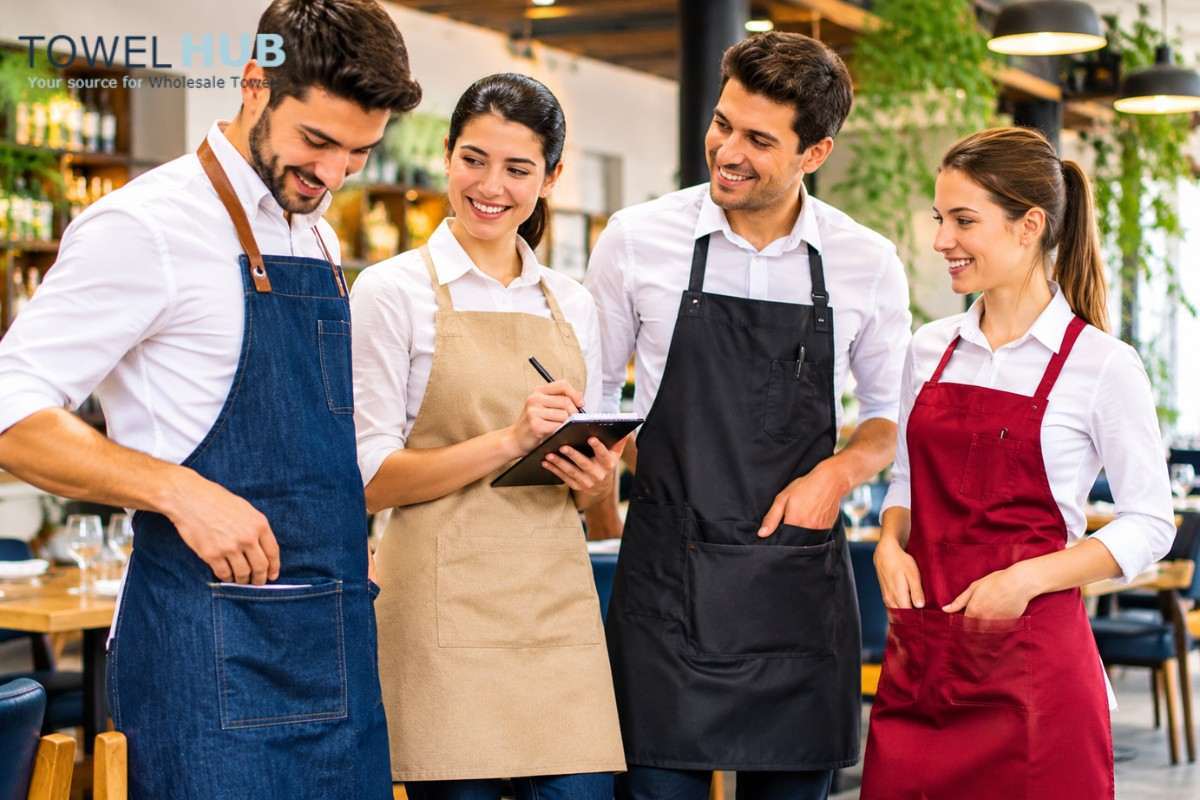
A restaurant apron should serve as more than a garment protector. It's also easy to use for small items that are used throughout a shift for servers, bartenders, and kitchen staff. Pads, pens, guest checks, bottle openers, and payment devices require a functional space.
But not all pocket arrangements are suitable for all positions. Multiple tables can necessitate compartmentalization on the front, and a bartender can use space for small tools. Employees in the kitchen may have other storage needs.
The right pocket design will rely on the type of work that employees are carrying, how often they are using those items, and how comfortable the apron is when used during lengthy working periods.
Recognizing these differences can assist restaurant owners in selecting uniforms that will aid them during the day without taking up too much space.
Common Apron Pocket Styles for Restaurant Service
Having the right number of compartments is just one aspect of a good apron design. The pocket width, depth and location dictate if employees are able to access their essential items without impacting their work. Here are a few of the most practical uniforms that are utilized in restaurants.
Single Large Front Pocket
A single large front compartment allows for easy access to an employee's order pad, guest check and a few small accessories. It has the disadvantage of a lack of organization. They can accumulate at the bottom and are not easily found during hectic work periods.
Divided Two Section Pocket
The pocket is divided so that frequently used items are separated, but with minimal bulk. Pens or receipts may be stored on one side of the order pad and the order pad on the other side of the pad. This is especially useful when a waiter's apron must stay small yet offer ample space for the everyday requirements of service.
Three Section Front Pocket
Three compartments for greater control over smaller objects. A server can provide different areas for writing supplies, guest checks and payment accessories. The divisions need to be sufficiently broad to allow the employees to use the divisions for what they actually carry, rather than making very narrow divisions which are of little practical value.
Narrow Pen Compartments
The writing instrument is kept from getting lost underneath receipts and other supplies in a dedicated pen slot. It must not take up the pen in such a way that it is difficult to remove. The stitches around the opening should also be reinforced to ensure that the opening doesn't become loose during the course of a shift.
Side Access Pockets
Side positioned compartments offer convenient storage without a cluttered front to the garment. They're also convenient for small tools and personal work needs. They should be positioned so that an employee can comfortably reach in without getting the pocket caught between tables or counters.
If you want to compare the style of the garments in a wider context, check out this guide to what's popular among the chefs and servers.
Matching Pocket Arrangements With Restaurant Positions
The Uniforms should be appropriate to the job of the person wearing them at the restaurant. A front-of-house design that is successful might not meet the needs of a kitchen's space or coverage. The application of uniforms based on the position is easier.
Waist Aprons for Servers
Waist design allows the upper body to be uncovered and holds frequently used items around the hip area. For employees who bring order pads, pens, and guest checks, a half apron with pockets would be appropriate. It is also easier to maneuver around due to its shorter length when walking between tables set close together.
Bib Aprons for Kitchen Employees
Covers the lower body and chest. An upper section of a chef's apron can have a thermometer or marking stick, while a larger storage section is located below for more substantial items. Pocket openings should be functional and should not hinder food preparation tasks.
Bistro Aprons for Table Service
A longer waistline provides more bottom coverage without being too revealing. They are ideal for use in full-service dining rooms where staff often serve food from table to table. A divided writing surface on a waiter's table will keep guests' checks and writing supplies organized, while minimizing the bulk at the front.
Bartender Aprons With Tool Storage
Bartenders often have a variety of small equipment, including bottle openers, bar keys, pens, and more. They fit better into a deeper utility box than a shallow decorative box. Alternatively, a tool loop could be considered to ensure access to commonly used equipment.
There are different uniform requirements for various beverage service jobs. For baristas and bartenders, this is a comparison of some apron designs.
Cashier and Host Aprons
Typically, cashiers and hosts do not require as much storage as do servers that are responsible for multiple tables. Compartments can be used for pens, receipts, and reservation notes, as well as accessories.
Construction Details That Affect Pocket Performance
Even though it's well organized, a poorly made pocket might end up being cumbersome. Fabric, stitching, size, and fit all affect garment performance during use. These are all important points restaurant buyers need to consider when choosing uniforms.
Pocket Depth and Opening Width
A pocket should be just deep enough for the items to be securely held, but not so deep that it will be hard to retrieve objects. But the opening width is important as well. Take the measurements of ordering pads, payment devices, and other equipment employees use prior to choosing a specific design.
Reinforced Pocket Corners
Regular pulls are done by pocket corners, especially with phones and heavier tools for service. These areas are reinforced for extra protection during normal usage. Buyers need to check the attachment places and stitching, let go of appearances.
Keep Cash & Receipts in Secure Storage
There should be reduced hazard of bills and receipts falling out of the cash compartments for staff working with cash. A wider pocket or another appropriate closure may prove helpful. But, certainly, the best solution for cash storage, an apron should not be considered as a secure system, especially at times when employees are shifting between the public areas.
Comfortable Pocket Placement
An otherwise good design may be an uncomfortable item if it is poorly placed. Pockets set too low can compromise sitting/standing, and those set too near to the side are hard to get to. Safety issues can be determined by testing the garment during normal movements.
Fabric and Washing Requirements
The project required fabric and washing needs. This involved fabric and washing requirements.
Any pocket seams and fabric should be able to withstand the typical laundry cycle at a restaurant. Stitching, shape, and durability of fabric will be compromised with repeated washing.
When purchasing wholesale aprons, investors who intend to buy restaurants should also take these considerations into account.
Selecting the Right Apron Pockets for Bulk Restaurant Orders
When purchasing all the uniforms for a restaurant, you'll need to plan so that you can get them at a reasonable price. Owners should take into account the duties of the employees, storage needs, appearance and replacement of the machine. Allowing an evaluation sample to fix the issue before you get the big order.
Simple Designs for Everyday Service
For those who wear an order pad, pens, and guest checks, a simple bimodal design might suffice. Unnecessary dividers multiply bulk and don't add to organization. If you have a restaurant that wishes for uniformity in the appearance of the front-of-house staff, the black server apron with pockets is a sensible alternative.
Additional Storage for Busy Employees
Other staff members may have multiple tools on their person and require additional space for them to store. More than one pocket should be included in aprons as long as the design of pockets does not make the apron uncomfortable to use. Extra storage must be for a specific reason and not just to make the number of pockets bigger.
Consistent Uniforms Across Restaurant Locations
Whenever restaurant groups have more than one operation, they should establish common requirements prior to placing an order. Determine the position of storage (chest, divided waist, individual tool space). By standardizing these requirements, replacement purchases will be easier and for a more consistent look.
Sample Testing Before a Large Purchase
A pocket photo just will not show the "stuffedness" of the pocket during actual shift. Have staff sample with work standard equipment. Test for comfort when using on the move; note if order pads fit, if pens stay secure, and if the compartments stay comfortable when bending and sitting.
Before selecting the right pocket restaurant apron uniform for the restaurants, they can consider the readily available black apron and multi-pocket restaurant models.
Balancing Purchase Price With Durability
Be careful about good value versus poor value. Low prices, weak seams, poor comfort (narrow pockets, too short, too wide), or poor zippers can cause frequent replacement. When choosing multi-pocket waitress aprons for the whole team, compare fabric quality, the way the Hypalon is constructed, how it should be washed, and how comfortable it is overall.
The 3 Pocket Bib Apron is a particular design of divided storage that has a suggestion for two lower book pockets and a clear pencil pocket.
Frequently Asked Questions
How many pockets should a restaurant server apron have?
Bear in mind that most servers will require two or three compartments.
Offer a writing area, guest checks, and small accessories, all in a separate area without making the garment unnecessarily bulky.
Are waist aprons better than bib aprons for restaurant staff?
This is most dependent upon the task. If employees require hassle-free access to service requirements and increased upper body mobility, then waist aprons are suitable. Styles of bibs include extra covering and breast room for kitchen and beverage service personnel.
What should restaurant servers keep in their aprons?
Most often you have order-taking papers, two pencils/pens and guest checks, plus possibly a payment machine if needed. Bar staff can also use a bar key and/or bottle opener. Staff should avoid taking in and carrying personal possessions at service unless necessary.
What makes a restaurant apron pocket durable?
Strength and reinforcement at the corners, good stitching, and well-finished openings add to durability. Ongoing checks and adhering to the manufacturer's cleaning guidelines will also help preserve the pocket construction.
Are multiple pocket aprons suitable for every restaurant employee?
No – extra compartments can be useful for heavy-handed members of staff who hold more than one tool, but not for staff who have several tools to carry about. The work conducted by the employee should be displayed in the pocket arrangements.
Conclusion
The best apron pocket design depends on what restaurant employees need to carry and how they work throughout a shift. Divided compartments suit servers, deeper storage helps bartenders organize their tools, and kitchen employees may benefit from a combination of chest and lower pockets.
Fabric strength, stitching, pocket placement, and washing requirements deserve equal attention when selecting uniforms. For restaurant owners planning a new uniform order or replacing existing garments, TowelHub offers a starting point for comparing available styles.